Showing posts with label Honiton. Show all posts

Friday, 20 November 2015

Inaugural exhibition at Woodhayes Gallery

November saw the culmination of many years' work - our inaugural exhibition at Woodhayes Gallery!

It has been a long build up. It was early 2011 when we first mooted the idea of a new exhibitions' space with the South West art community, who confirmed our suspicions that there was a lack of good exhibition venues for hire.

The conversion of the Dutch Barn started in 2013. By 2014 it was complete and we now had a purpose-built, contemporary exhibitions' space making the most of the spectacular light from the floor to ceiling windows and incorporating the very latest gallery lighting and hanging systems.

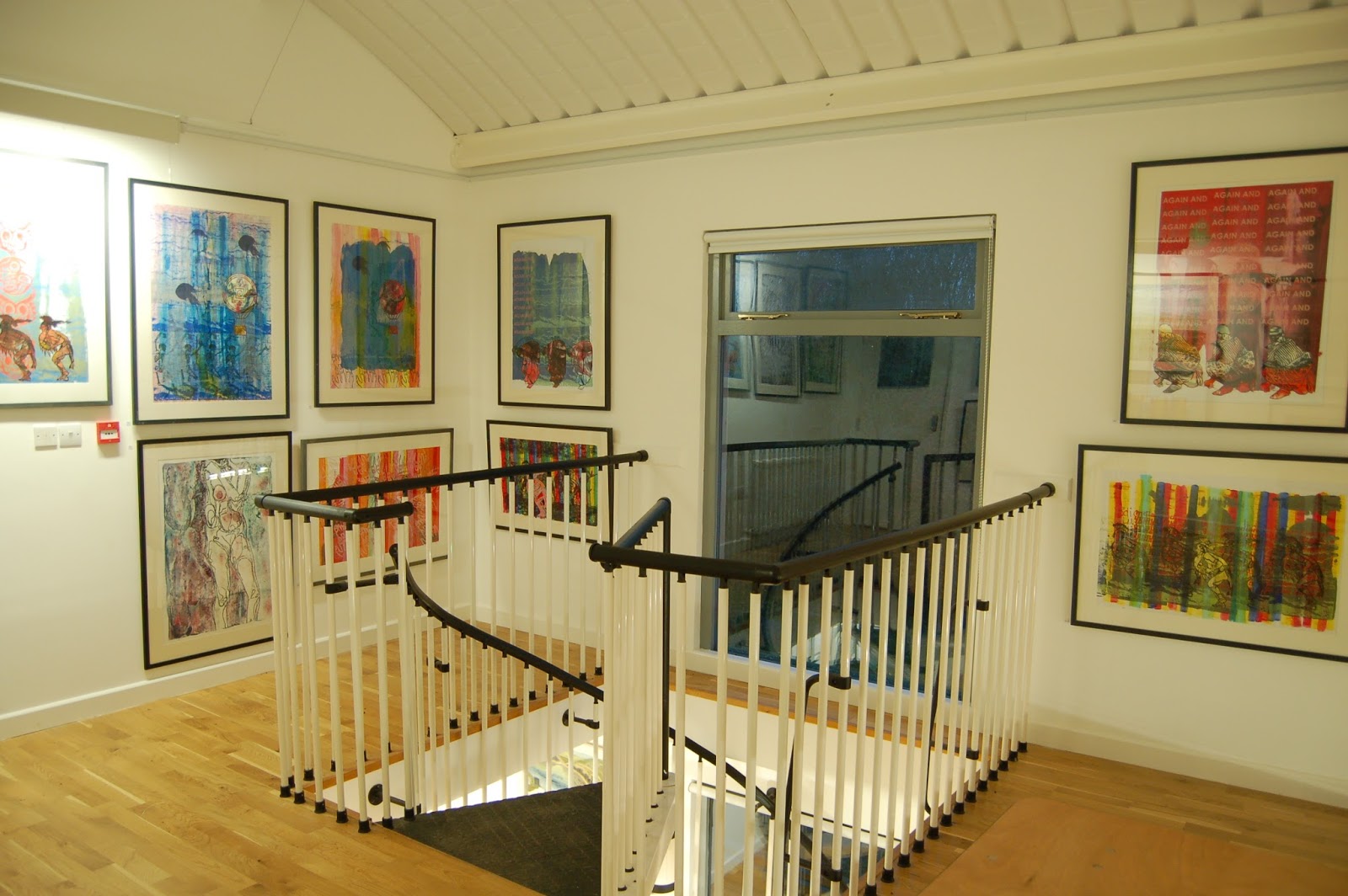
The inaugural exhibition : 'Metamorphosis' (7 -18 November) featured the work of two South West artists - Dick Hewitson and Maisie Parker who had hired the gallery space.

Dick Hewitson is a Dorset painter, mainly painting in oils, whose interpretations of landscapes range from contemporary figurative to abstract. After initial research in the field, creating rapid sketches in pencil, ink or charcoal, Dick returns to creat the artwork in his studio. He often incorporate charcoal marks into his oil paintings too. Colour is a significant aspect of his work, blending subtle colour mixes for his paintings. You can see more here : http://www.dickhewitson.co.uk/exhibitions.php
Walking Dorset - Dick Hewitson
Maisie Parker is an artist who works in mixed print media, although drawing is at the heart of her work. She explained "Drawing is a way of knowing, a mode of enquiry and a visual language. Life drawing is the source of all my print work and is ongoing. It is the most important part of my art."
Maisie Parker
The Private View was held on Saturday 7 November to much excitement and we have enjoyed the last few weeks and learnt much along the way. We have welcomed artists from across the region throughout the exhibition to view the space, so exciting times are ahead!


Monday, 9 February 2015

Archaeological finds at Woodhayes

We have uncovered some exciting finds at Woodhayes thanks to Seán Goddard, a geophysicist from the Archaeology Department at Exeter University. He visited Woodhayes to look at the topography and discover more about its history.

Smelting in the Blackdown Hills

Various surveys have found evidence of ironworking in the Blackdown Hills, where we are based. There is some evidence for prehistoric smelting, the Romans may have continued this and it carried on into the medieval period.

The industry grew here due to the geology and abundant timber - a fuel source for the furnaces. The area is dominated by an outcrop of 'Upper Greensand', which gives the characteristic long level plateaux of the hills. The iron is located in the upper levels of the Greensand. Extraction pits are still visible locally at Kentisbeare, Broadhembury and Sheldon.

Sean told us that the ore from the Greensand plateaux is Siderite- not the best ore in the world- but is self-fluxing (meaning it is free running) and easy to smelt.

Evidence

The majority of evidence is based on finds of distinctive 'tap slag', which had been tapped from the furnace in a fluid state. The larger pieces have a glossy, rippled surface produced by the hardening of successive flows of molten slags from the base of the furnaces. They have been used as building materials notably in the 14 Century walls of Hemyock Castle. The largest piece recorded so far was found at Upottery and weighed 8.8kg. Below is the piece found on the Woodhayes land.


Slag found at Woodhayes


Dating

There is a C14 early Roman (AD 50-70) dated slag deposit in Upottery, we strongly suspect what we have is also Roman. The Roman military must have had the iron franchise in the area and we hope Woodhayes might have been their base.

Other finds

We also found a sherd of pottery adjacent to a pipe trench in the field. Sean's pot expert believes it is 18th Century trailed slipware from Donyatt, Somerset and related kilns (which may have included Honiton too.) It comes from the shoulder of a closed form such as a bucket-handled pot or a chamber pot.


Donyatt pottery sherd

 
Sean plans to return as he would also like to visit the charcoal deposit in Crownall wood. This is likely to be a charcoal burning platform and if so, would support the case for iron smelting in the immediate area.

All very interesting ! Watch this space for more details